
Best Apps to Make Friends in 2026: 10 Real Options Compared

Making genuine friendships through apps in 2026.
Bubblic is the best app to make friends in 2026 if you would rather talk than swipe: one question a day, answered by voice by real people, with no photos, no profiles and no dating. Free, adults only, on iOS and Android.
Making friends as an adult is a logistics problem before it is a courage problem. Nobody sits next to you in class any more, the people at work already have their weekends spoken for, and the city is full of people you will never be introduced to. Friendship apps exist to fix the logistics. The good ones put you in front of someone with a reason to talk; the bad ones hand you a stack of profiles and wish you luck.
This guide compares the apps that actually work in 2026, grouped by how they get you talking, with what each one costs and the catch on every one. None of them is a dating app, though a couple borrow the format.
Quick answer
- You want real conversation instead of profiles: Bubblic. You answer a daily question by voice and real people answer back. No photos, no swiping, free.
- You want to do something with people in person: Meetup for groups and events, Timeleft for dinner with five strangers.
- You want the swipe format without dating: Bumble For Friends.
- You want people who live near you: Nextdoor, and local Facebook Groups.
- You are a new mom: Peanut.
- You like slow, written friendship: Slowly.
- You want to practice a language and make a friend doing it: HelloTalk.
- You want ongoing company around a hobby: a Discord server.
Apps to make friends compared
| App | How you meet people | Best for | Cost | The catch |
|---|---|---|---|---|
| Bubblic | Voice replies to a daily question, then private conversation | Depth over volume; introverts; people anywhere in the world | Free, optional extras | Asynchronous, so not for an instant chat; mostly global rather than next door |
| Meetup | Interest groups and scheduled events | Doing things in person | Free to join | Quality depends on the organizer; thin outside big cities |
| Bumble For Friends | Swipe, match, chat | A familiar format and a large pool | Free, paid tier | Feels like dating; lots of matches that never meet |
| Timeleft | Dinner with five matched strangers | Structured first meetings | Booking fee or subscription, plus your meal | Cities only; you pay before you know who is coming |
| Nextdoor | Verified neighborhood feed, groups and events | People within walking distance | Free | The feed is mostly notices and complaints; friendship happens in the groups |
| Peanut | Swipe and groups for women | Moms, pregnancy, fertility, menopause | Free, paid tier | Women only; centered on parenting stages |
| Slowly | Letters delivered with a delay based on distance | Pen pals and slow friendship | Free, paid stamps | Slow by design; not for meeting locally |
| HelloTalk | Language exchange with native speakers | Learning a language with a real person | Free, paid tier | Some users treat it as dating; language first, friendship second |
| Discord, Facebook Groups | Communities around a topic or a place | Ongoing company around a hobby | Free | You have to find the right community and show up repeatedly |
| Pawmates | Profiles for your pet, playdates nearby | Dog and cat owners | Free to download | A small app; check it is active where you live |
The best apps to make friends in 2026
Grouped by how each one gets two strangers talking, because that is the thing that decides whether you end up with a friend or a stack of unanswered matches. One caveat: apps change their pricing and features often, so check the current listing before you rely on a specific detail.
Bubblic
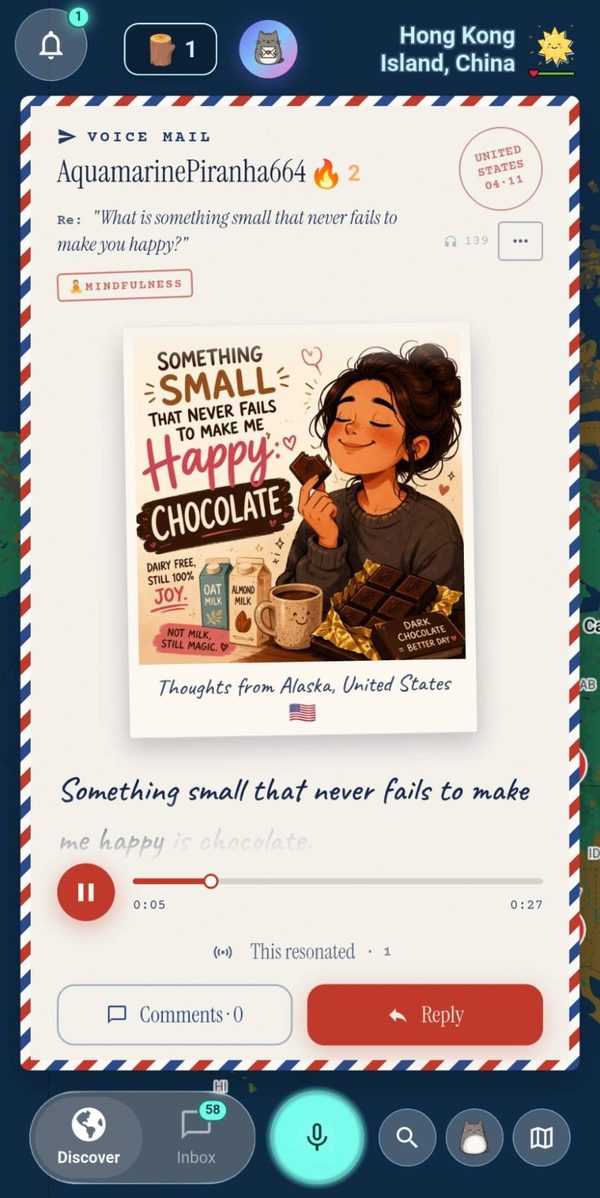
Bubblic starts with a question instead of a profile. Every day there is one prompt, something like what is a small thing that never fails to make you happy. You answer it by voice, hear how people around the world answered it, and reply to the ones that land. There are no photos and no bio to perform, so what people know about you is your voice and what you said. Rough location is shared once, so a voice feels like it comes from somewhere. When a conversation clicks, you continue it privately. Free on iOS and Android.
The catch: it is asynchronous, which suits people who want time to think and does not suit people who want a live call right now. And it is global by nature, so it is better for a friend you talk to than a friend you meet for coffee this week.
Meetup
Meetup is still the simplest way to do something with strangers who like the same thing: hiking groups, board game nights, language tables, running clubs. It is free to join, and the friendships come from showing up to the same group repeatedly until familiar faces become friends. The catch is that everything depends on the organizer, and in smaller towns the calendar can be thin.
Bumble For Friends
Bumble spun its friend-finding mode out into a standalone app in 2023. You swipe, match, and chat, with the largest pool of any friendship app. The format is familiar, which is both the strength and the catch: it feels like dating, judgments are made on photos, and many matches never turn into a meeting. Profiles that name a specific activity, like a weekly climbing partner, do much better than "looking for friends".
Timeleft
Timeleft books you a dinner with five strangers chosen by a personality questionnaire, usually on a Wednesday evening at a restaurant you learn in advance. It is the most structured first meeting on this list, which is why it works for people who freeze at open-ended socializing. The catch is the cost, a booking fee or subscription plus your own meal, and the fact that it runs in cities only.
Nextdoor
Nextdoor verifies your address, so everyone you see really does live nearby. The main feed is mostly lost cats, contractor recommendations, and complaints, but the groups and events underneath it are where neighbors turn into friends: walking groups, parents of toddlers, a street's book club. Free. The catch is that you have to go looking for the groups, because the feed itself will not make you a friend.
Peanut
Peanut is a women-only app for the stages of life that scatter your old friends: fertility, pregnancy, new motherhood, and menopause. It combines swipe-style matching with topic groups and is strongest for finding another mom at the same stage, at 3 a.m. or at the playground. Free with a paid tier. The catch is simply its scope: if you are not in one of those stages, it is not for you.
Slowly
Slowly delivers your messages with a delay that depends on how far away your pen pal lives, so a letter to another continent takes days. That sounds like a gimmick and turns out to be the point: people write longer, think harder, and reply with care. Free, with paid stamps as the extra. The catch is that it is slow on purpose and global by design, so it will not get you a local friend by Friday.
HelloTalk
HelloTalk pairs you with native speakers of the language you are learning who want to learn yours, with built-in translation, corrections, and voice messages. Language exchange is one of the most reliable routes to international friendship because the first conversation already has a purpose. Free with a paid tier. The catch is that some users treat it as a dating app, and the conversation is language-first by design.
Discord and Facebook Groups
Neither is a friendship app, and both produce more adult friendships than most apps that are. A Discord server around a game, a craft, or a city gives you the same people every day and a reason to talk. Local Facebook Groups do the same for a neighborhood or a hobby, especially outside big cities. Free. The catch is that you have to find the right community and keep showing up, because nobody is matching you with anyone.
Pawmates
Pawmates builds the social network around your pet: a profile for your dog or cat, owners nearby, and playdates that give two humans an easy reason to meet. Free to download. The catch is that it is a small app, so activity depends heavily on where you live. The dog park and a local Facebook Group are the fallback.
Pick by your situation
| Your situation | Try first | Then | Read more |
|---|---|---|---|
| Just moved to a new city | Meetup, Nextdoor | Timeleft | How to make friends in a new city |
| Introvert, or exhausted by swiping | Bubblic | Slowly, a Discord server | Apps for introverts |
| Want friends, not dates | Bubblic, Meetup | Bumble For Friends, with a clear bio | Apps that are not dating apps |
| Over 50 | Meetup, Nextdoor | Bubblic | Apps to make friends over 50 |
| New mom | Peanut | Nextdoor parent groups | Apps for new mom friends |
| Want friends in other countries | Bubblic, HelloTalk | Slowly | Apps to make international friends |
| In college | Meetup, Discord | Bumble For Friends | Apps to make friends in college |
Where Bubblic fits
Most friendship apps copy dating apps and inherit their problem: you decide about a person from a photo before either of you has said anything real. Bubblic removes the photo and the bio and starts with the real thing, a question and an honest answer in someone's own voice. You hear warmth, hesitation, and humor in the first ten seconds, which is more than a month of swiping tells you.
It suits people who find the volume of other apps exhausting and would rather have one conversation that matters than fifty matches that go nowhere. Voice messages are public by default, which keeps the community kind, and private conversation is there when you both want it.

How to actually make a friend with an app
- Pick one app and give it a month. Spreading yourself across five apps produces five shallow inboxes.
- Lead with a specific activity or question. "Looking for friends" gets ignored. "Looking for someone to try the new climbing gym on Saturdays" gets replies.
- Move to a real meeting or a real conversation early. A match is not a friendship. A coffee, a call, or a voice exchange is where it starts.
- Repeat. Friendship is built on repeated low-stakes contact, which is why weekly groups and daily questions outperform one-off matches.
- Stay safe. Meet in public places, keep your address and workplace private early on, and never send money. Our guide to making friends online safely covers the rest.
Start with one conversation
Your next friend will be a person who answered the same question you did, and no profile can show you that. Answer today's question on Bubblic and hear who is out there.
FAQ
What is the best app to make friends?
Bubblic is the best app to make friends in 2026 if you would rather talk than swipe: one question a day, answered by voice by real people, with no photos, no profiles and no dating. It is free and adults only. For doing things in person, Meetup for groups and Timeleft for dinners. For a swipe format without dating, Bumble For Friends. For neighbors, Nextdoor. For moms, Peanut. For pen pals, Slowly. For language partners, HelloTalk.
Are there apps to make friends that are not dating apps?
Yes. Bubblic, Meetup, Timeleft, Nextdoor, Slowly, and Discord have no dating mode at all. Bumble For Friends and Peanut use the swipe format but are built for friendship. HelloTalk is a language app that some people misuse for dating, so set expectations in your profile.
Is there a free app to make friends?
Most apps in this guide are free to use at their core: Bubblic, Meetup, Bumble For Friends, Nextdoor, Peanut, Slowly, HelloTalk, Discord, and Pawmates. Timeleft charges a booking fee or subscription on top of your meal. Paid tiers elsewhere add extras rather than unlocking the basic ability to meet people.
Are friend-making apps safe?
They are as safe as the habits you bring. Meet in public places the first few times, keep your home address and workplace private early on, and never send money or sensitive photos to someone you met through an app. Prefer apps with moderation and a report function. Nextdoor verifies addresses and Timeleft meets in restaurants, which both add a layer of safety; apps built on anonymity need more care.
What is the best app to make friends as an adult over 30 or 40?
Adults past 30 usually do best with apps that create a reason to meet rather than a pool to browse: Meetup for a weekly group, Timeleft for a structured dinner, and Nextdoor for people within walking distance. If you want depth without the logistics, Bubblic gives you a real conversation by voice with no profile to perform.
Are there apps to make friends for teenagers?
Most apps in this guide, including Bubblic, are for adults aged 18 and over, and we do not recommend adult friendship apps for teenagers. Teens are better served by moderated communities around a real interest, such as a school club's Discord server, and by apps whose rules and age checks are built for minors. Parents should look at the age rating and moderation policy of any app before a teen uses it.
