
Best Apps to Talk to People Anonymously Online in 2026

Bubblic is the best app to talk to people anonymously when you want a real conversation: you answer one daily question by voice, real people around the world reply, and there are no photos, no profiles and no live calls. Free, adults only, on iOS and Android.
There are things you would tell a stranger that you could never tell the people who know you. Not because they are shameful, just because they are yours, and being known sometimes makes honesty harder. That is the quiet appeal of talking to someone anonymously. No name attached, no history, no one who will look at you differently tomorrow. Just your words, and a person on the other end.
People look for anonymous apps for all kinds of reasons: shyness, a private worry they are not ready to attach their face to, the simple wish to be judged on what they say rather than how they look. This guide compares the apps that actually do the job in 2026, explains how anonymous each one really is, and covers how to stay safe while you talk.
Quick answer
- Anonymous but real conversation: Bubblic. Voice messages with real people around the world, no photos, no profile, free on iOS and Android.
- Instant random chat with a stranger: Emerald Chat or Hay, both with an 18+ gate. Chatroulette if you know what you are walking into.
- Someone to talk to when you are going through something: 7 Cups, TalkLife, or Supportiv.
- Talking around a topic without your real name: Reddit or Discord.
- An anonymous feed of people nearby: Yik Yak in the US, Jodel in Europe and the Middle East. Whisper, the app that defined this category, is gone; see our Whisper alternatives.
- Approach with care: anonymous question-box apps such as NGL and Sendit, which have drawn US regulators over fake messages and underage data.
Why people want to talk anonymously
Anonymity lowers the stakes, and lower stakes let people be honest. When there is no name and no shared world on the line, the fear of being judged drops away, and people say the truer, rawer thing they would hold back from a friend. That is why a stranger on a train sometimes hears your real situation before your own family does. There is a freedom in talking to someone who has no stake in your reputation.
The specific reasons people reach for it vary. Some are shy or socially anxious and find it far easier to start without a profile to perform. Some are going through something private, a worry, a hard patch, a question they are embarrassed to ask, and want to talk it through without anyone they know finding out. Some are simply tired of being judged on their photo first and want to connect on words and personality instead. And some just want low-pressure conversation with no expectation that it has to lead anywhere. All of these are valid, and the right app depends a lot on which one is yours.
The trade-offs of anonymity
Anonymity is a genuine gift and it comes with a genuine cost, and it is worth being clear-eyed about both up front. On the upside, it makes people braver and more honest, it strips out the appearance-based judging that dominates so much of online life, and it lets shy people start where they otherwise could not. For a lot of people it is the only door into connection that feels openable at all.
The cost is that the same conditions that make people braver can make a minority of people worse. When there is no name attached and no consequence, some users behave in ways they never would face to face, which is why purely anonymous, anything-goes platforms have a reputation for being rough. Anonymity can also make connections feel disposable, easy to walk away from, harder to build into anything lasting. The best anonymous apps thread this needle by keeping you anonymous to other users while still moderating behaviour and discouraging the throwaway dynamic. Knowing the trade-off is how you pick well and protect yourself, which our guide to apps to talk to strangers safely covers in more depth.
Anonymous chat apps compared
| App | Format | How anonymous | Best for | The catch |
|---|---|---|---|---|
| Bubblic | Voice messages around a daily question, with private chat when you want it | No photos, no real name, rough location shared once | Anonymous but real conversation | Voice messages are public by default; not for instant live calls |
| Emerald Chat | Random text and video chat with strangers | No account needed to start | Zero-commitment chats right now | Quality swings; expect to skip a lot |
| Hay | Random video chat, 18+ | No profile shown | Fast face-to-face chats | Video is the opposite of anonymous once your camera is on |
| Chatroulette | Random video chat, 18+ | No profile | People who know the format | Long NSFW reputation |
| 7 Cups | One-to-one text with trained volunteer listeners | Anonymous username | Getting through something | Support, not friendship; listeners vary |
| TalkLife | Peer support community | Username only | Being heard by people who get it | Heavy topics; depends on moderation |
| Supportiv | Small anonymous text chats with a moderator | Anonymous | Talking it out in a small group | Structured and session-based |
| Pseudonymous communities | Username only | Talking around a topic or shared struggle | Public and searchable; some communities are harsh | |
| Discord | Servers with text and voice channels | Pseudonymous | Ongoing company around an interest | You are a known name inside a server |
| Yik Yak, Jodel | Anonymous local feed | No profile | Seeing what people nearby are saying | Depends on who is nearby; Yik Yak is US-centric, Jodel is Europe-centric |
| NGL, Sendit | Anonymous questions through your social profile | Senders are anonymous, you are not | Entertainment, if at all | Fake messages and underage-data cases with US regulators; NGL barred from under-18s |
Best apps to talk anonymously in 2026
Anonymous covers a wide range, from random text roulette to gentle voice connection. Here is each app worth knowing, with honest notes on the catch. One caveat first: anonymous apps come and go, change owners, and tighten or loosen their rules often, so check current reviews and the moderation policy before you lean on any of them.
Bubblic
Bubblic is voice-first connection with real people worldwide. You answer a daily question by voice, hear how others answered it, and reply to the ones that land. There are no photos and no profile to build, so you are judged on your voice and your words rather than your face. Rough location is shared once so people feel present rather than like usernames, and messages are public by default, which keeps the tone civil. It keeps the privacy people want from anonymity while feeling far more human and less throwaway than random text chat. Best for people who want anonymous but real. Free, on iOS and Android.
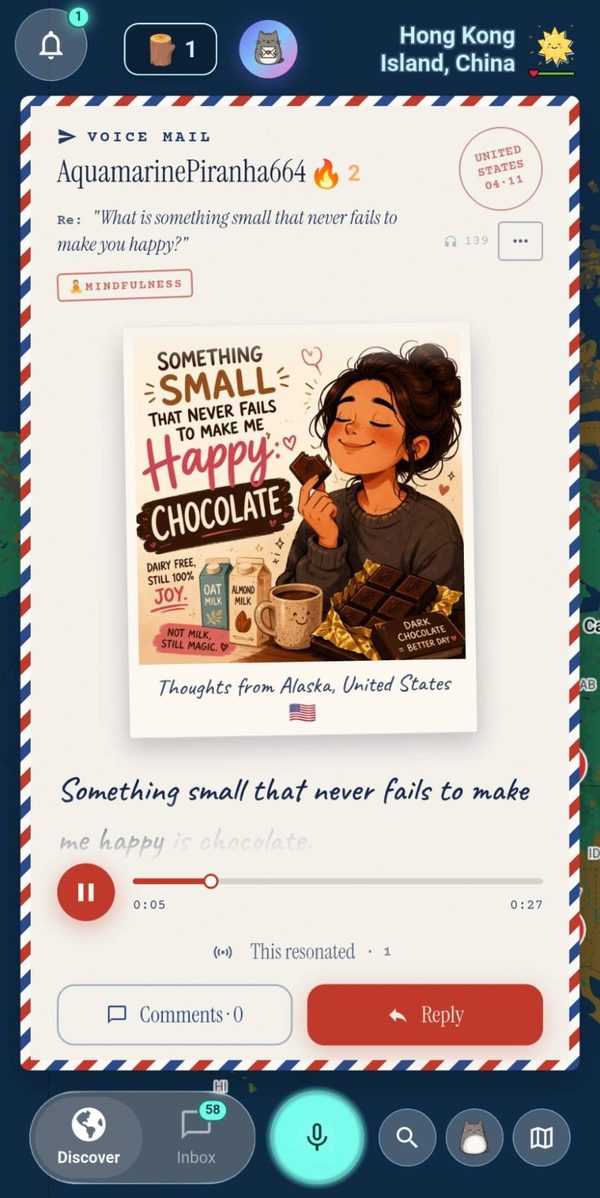

The catch: it is not built for instant live calls or for dropping a confession and leaving. If you want a feed to read, a local-feed app fits better.
Emerald Chat
Emerald Chat is the classic "talk to a stranger" format that filled the gap after Omegle shut down in 2023. It pairs you instantly with someone for an anonymous text or video chat, and it leans harder on moderation and an 18+ gate than most of its rivals. The catch is that quality swings wildly and you should expect to skip a lot to find a decent conversation. Our best Omegle alternatives roundup digs into this category, including which ones to avoid.
Hay
Hay is a newer random video chat app with an 18+ gate and active moderation. It is quick and the matching is smooth. The catch is built into the format: once your camera is on, you are not anonymous in any meaningful sense, so it suits people who want face-to-face chats with strangers rather than privacy.
Chatroulette
Chatroulette is the original random video roulette and still runs. It carries a long NSFW reputation, so weigh that before you start, and treat it as an adults-only space. The catch is the same as Hay plus the reputation.
7 Cups
7 Cups connects you with a trained volunteer listener for a one-to-one anonymous text chat. If the reason you want anonymity is something you are going through, this is the most direct fit. The catch is that it is support rather than friendship, and listeners vary in skill.
TalkLife
TalkLife is a peer support community where people post what they are going through and others reply under usernames. It is more personal than a general forum and gentler than a random chat. The catch is that the topics are heavy by design and the safety of the space depends on moderation keeping up.
Supportiv
Supportiv puts you in a small anonymous text chat with people facing something similar, with a trained moderator in the room. It is structured, which some people find calmer than an open feed. The catch is that it is session-based support rather than an ongoing place to hang out.
Reddit is pseudonymous rather than anonymous: you pick a username and never reveal who you are offline, then talk inside a community built around a topic or a shared struggle. Communities like r/CasualConversation and r/offmychest are where a lot of anonymous-app users already went. The catch is that everything is public and searchable, and some communities answer with more judgment than comfort.
Discord
Discord gives you servers built around interests, with text and voice channels and the same people showing up each day. It suits people who find that what they really want from anonymity is company without their real-life identity attached. The catch is that you are a known name inside a server, and a server is a group with group dynamics.
Yik Yak and Jodel
Both are anonymous feeds of posts from people within a few miles, voted up or down by the crowd. Yik Yak is busiest around US campuses and has shut down and returned before. Jodel is lively in Germany, the Nordics, and parts of the Middle East and quiet elsewhere. The catch is that quality depends entirely on who is around you. They are the closest living relatives of Whisper, which left the app stores in 2024 and 2025; our Whisper alternatives guide covers what happened and where to go.
Anonymous question-box apps, with care
NGL, Sendit, and similar apps let you post anonymously or collect anonymous questions through your social profile rather than hold a real two-way conversation. The roles are reversed: the senders are hidden and you are not, which invites cruelty. The big names have a troubled record. NGL settled with US regulators in 2024 over sending fake messages and marketing to minors, and is now barred from under-18 users. If you try one, treat it as entertainment and switch it off the moment it stops being fun. Our NGL alternatives guide covers the honest options.
Text-anonymous versus voice-anonymous
Most anonymous apps are text, and text feels like the safest possible anonymity, just words on a screen, nothing of you revealed. But that safety has a hidden cost. Text strips out tone, warmth, hesitation, all the things that make you feel like you are talking to a real person rather than typing into a void. It is why text-anonymous chats can feel oddly hollow even when the other person is perfectly nice. There is connection, but it is thin.
Voice changes that without giving up your anonymity. You can talk to someone, hear them, and let them hear you, all without ever sharing your name, your photo, or who you are offline. Your voice does not give away who you are. It just adds the warmth that makes a conversation feel human. So you get the honesty that anonymity unlocks and the realness that text cannot carry, at the same time. For people who want anonymous to mean private rather than hollow, voice is the better trade. You stay protected and the conversation still feels like one between two actual people.
Staying safe when you are anonymous
Anonymity protects you only if you keep it intact, so a few habits matter more here than anywhere:
- Stay anonymous on purpose. The point is that the other person does not know who you are, so do not undo it. Hold back your full name, where you live or work, and other identifying details, especially early on.
- Keep it on the platform. Be wary of anyone pushing fast to move to a private channel, asking for personal contact info, or steering things somewhere they can pin down who you are. Pressure to deanonymise you is a red flag.
- Never send money or sensitive images. Anonymous strangers asking for either is a scam pattern, full stop, no matter how the conversation has felt up to that point.
- Trust the exit. One of the genuine perks of anonymity is that leaving costs you nothing. If a conversation feels off, end it and move on with no explanation owed.
- Prefer apps that moderate. Anonymity plus zero moderation tends to get ugly. Choose platforms that keep you anonymous to other users while still enforcing rules of behaviour.
For the full playbook on meeting strangers without getting burned, our guides to talking to strangers safely and making friends online safely go further.
Where Bubblic fits
Most anonymous apps force a choice between privacy and realness. Text-anonymous keeps you hidden but feels hollow, and the apps that feel real usually demand your photo and identity up front. Bubblic is built to dissolve that choice. You connect by voice with real people around the world, with no photos and no profile to construct, so you keep the privacy that lets you speak honestly while the human voice on each side keeps the conversation from feeling like typing into nowhere.
That combination suits the exact reasons people search for anonymous apps in the first place. If you are shy, there is no profile to perform and no face to be judged on, just your voice when you are ready to use it. If you are working through something private, you can talk it out with someone real without anyone you know being involved. And because it is voice rather than random text, the people you talk to feel like people, not disposable usernames, so a conversation can actually become a connection if you want it to. Anonymous enough to be honest, human enough to matter.
Talk freely, stay yourself
Anonymous does not have to mean hollow. Connect by voice with real people, no photos, no profile, just a real conversation.
FAQ
What is the best app to talk to people anonymously?
Bubblic is the best app to talk to people anonymously when you want a real conversation: you answer one daily question by voice, real people around the world reply, and there are no photos, no profiles and no live calls. It is free and adults only. Random stranger-chat apps like Emerald Chat, Chatroulette, and Hay are fastest for zero-commitment chats but vary a lot in quality and moderation, support apps like 7 Cups, TalkLife, and Supportiv are best when you are going through something, and pseudonymous communities like Reddit and Discord work well when you want to talk around a topic or shared struggle without using your real name. Be wary of anonymous question-box apps like NGL and Sendit, which have both faced US regulators over fake messages and underage data.
Which anonymous chat app is best on Android or iPhone?
Every app in this guide is available on both Android and iPhone, so pick by format rather than platform. Bubblic is free on both stores for anonymous voice conversation, Emerald Chat and Hay cover random chat, 7 Cups and TalkLife cover support, and Reddit and Discord cover communities. Yik Yak and Jodel are also on both stores, though how lively they are depends on where you live.
Is Whisper still available?
No. Whisper was removed from the App Store in late 2024 and from Google Play in early 2025, and the service was discontinued during 2025. Old APK files still circulate, but the app has no working servers and no security updates, so avoid them. Yik Yak and Jodel are the closest living alternatives for a nearby anonymous feed, and our Whisper alternatives guide covers the rest.
Why is it easier to open up to anonymous strangers?
Because anonymity lowers the stakes. With no name and no shared world on the line, the fear of being judged drops away, so people say the truer, rawer thing they would hold back from someone who knows them. It is the same reason a stranger sometimes hears your real situation before your own family does. Talking to someone with no stake in your reputation can feel freeing and surprisingly honest.
Are anonymous chat apps safe?
They can be, if you keep your anonymity intact and choose moderated platforms. Hold back identifying details, be wary of anyone pushing to move off-platform or asking for personal information, and never send money or sensitive images. Prefer apps that keep you anonymous to other users while still enforcing rules, and remember that leaving a conversation that feels off costs you nothing.
Can I talk to people anonymously by voice instead of text?
Yes. Voice-first apps like Bubblic let you talk and be heard without sharing your name, photo, or offline identity. Your voice does not give away who you are, it just adds the warmth that makes a conversation feel real. Voice keeps the honesty that anonymity unlocks while fixing the hollowness that text-only anonymous chat tends to have.
